囧
- Literally
- 囧 (an archaic character meaning bright, read jiǒng)
- Meaning
- An ancient character pressed into service as the universal face of embarrassment.
- Popular since
- 2008
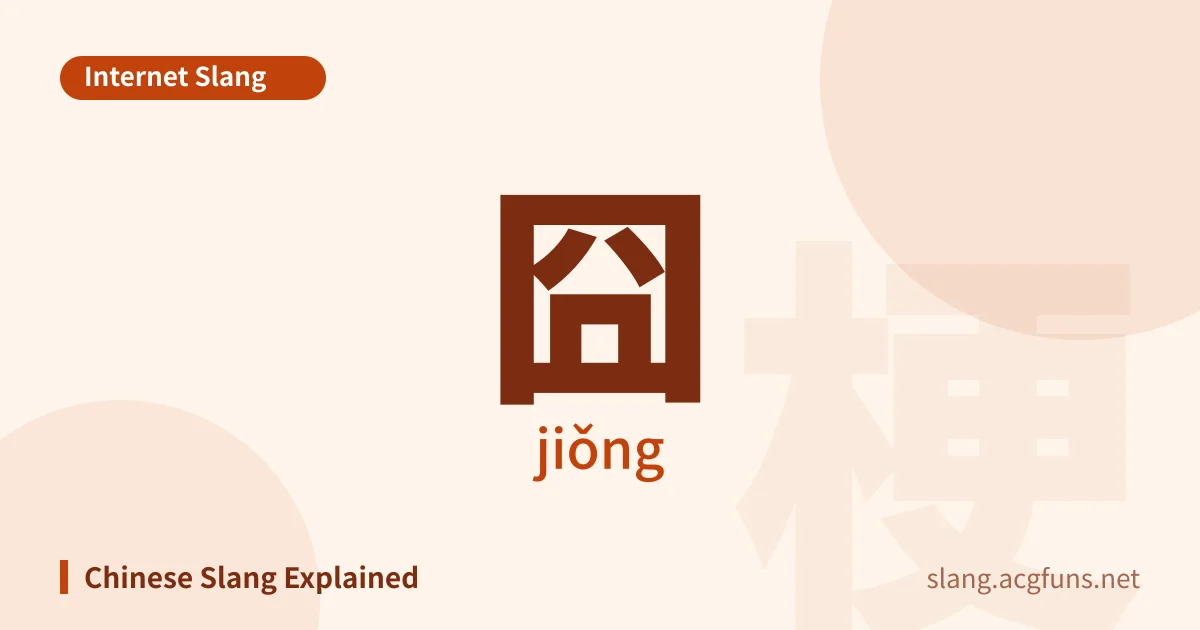
What does 囧 mean?
囧 is a real word from classical Chinese, meaning bright or the light that comes through a window, and it sat quietly in dictionaries for centuries. Then people looked at it again: the strokes on top droop like worried eyebrows, the square below opens like a slack mouth, and the whole glyph reads unmistakably as the face of someone who wants to disappear. That accident of typography turned it into the internet's default reaction to awkwardness. Its most famous form is 囧rz, the character as the head of a kneeling figure with outstretched arms, which is what you type when a situation leaves you speechless.
Where does 囧 come from?
The revival began on Taiwan's BBS boards in the 2000s, where users needed a single character to caption helplessness and 囧 happened to look exactly like the feeling. Mainland forums such as Mop and Tianya picked it up and ran with it around 2008. It appeared on T-shirts, in newspaper headlines and in linguistics articles about the comeback of a forgotten character. Unlike most fads of that era, it never really left: people simply kept typing it whenever words failed.
How to use 囧
- 面试官问我上一份工作为什么离职,我当场囧住,半天没憋出一句话。
Miànshìguān wèn wǒ shàng yī fèn gōngzuò wèishénme lízhí, wǒ dāngchǎng jiǒng zhù, bàntiān méi biē chū yī jù huà.
The interviewer asked why I left my last job and I froze in a full 囧 expression, unable to produce a single sentence. - 同学群里翻出我十年前的旧照,我只能回一个囧rz。
Tóngxué qún lǐ fān chū wǒ shí nián qián de jiù zhào, wǒ zhǐnéng huí yī gè jiǒng rz.
The class group chat dug up a photo of me from ten years ago and all I could send back was 囧rz.
Also available in: 日本語 · 한국어 · Español
Comments
Have you run into this word in the wild? Share where you saw it, who said it, and what happened.